Transformerless vs Transformer Solar Inverters: A Complete Guide for Indian Homeowners
When most people think about going solar, they picture the shiny blue or black panels sitting on their rooftops. And while panels are the visible stars of the show, they are actually quite simple devices: they take sunlight and spit out Direct Current (DC) electricity. But your television, refrigerator, air conditioner, and the entire public utility grid run on Alternating Current (AC) electricity.
This is where the solar inverter comes in. It is the unsung workhorse, the computational brain, and the electrical traffic controller of your solar system. It takes that raw, fluctuating DC voltage from your roof and converts it into clean, stable, phase-synchronized 230V AC electricity.
If you are currently getting quotes from solar installers in India, you have likely run into two terms: transformerless inverters (sometimes abbreviated as TL) and transformer-based inverters.
While both perform the same fundamental job of DC-to-AC conversion, they do it using radically different engineering philosophies. Choosing the wrong one can lead to lower energy bills savings, higher mounting structure costs, or even early equipment failure. Let’s dive deep into the differences, look at the math, and figure out which one is right for your home or business.
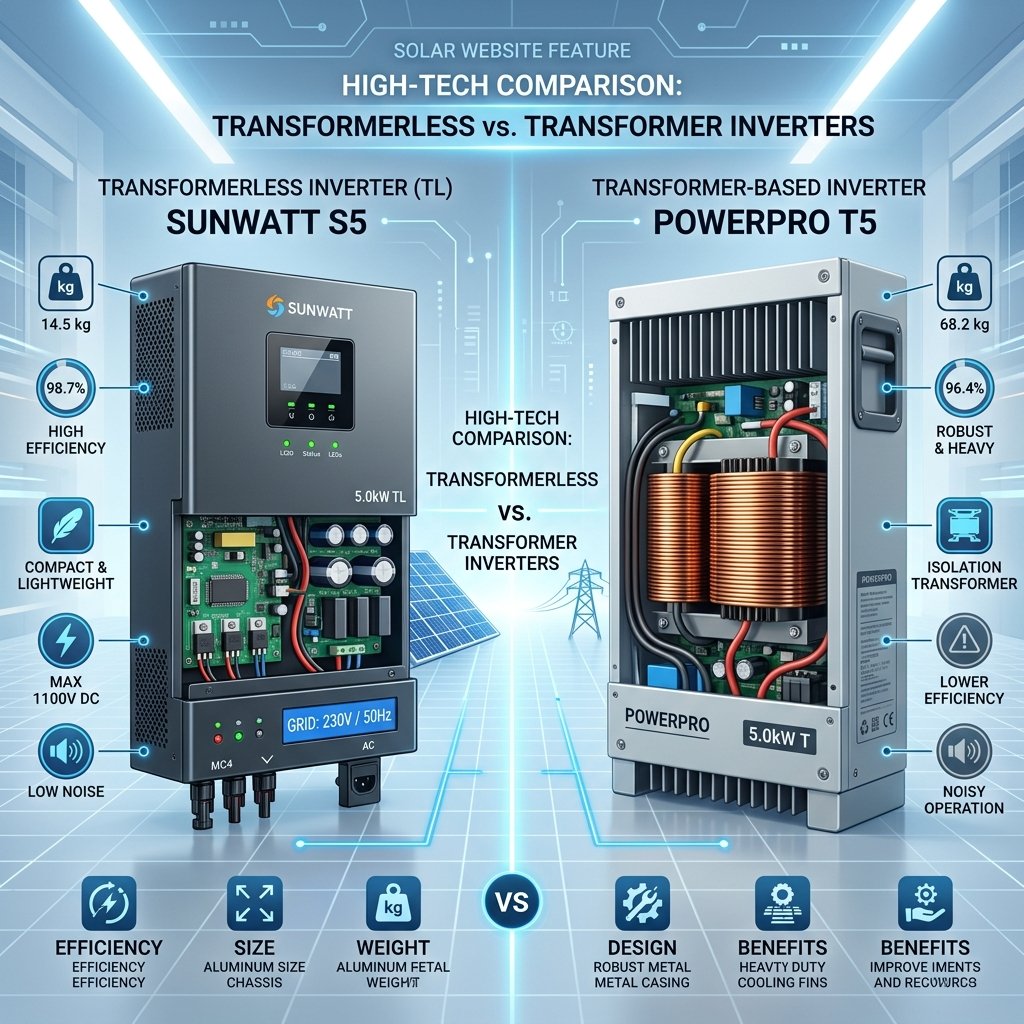
High-Tech Comparison: Transformerless vs. Transformer Inverters
What is a Transformer-Based Inverter?
For decades, transformer-based inverters were the only option. In these traditional systems, the inverter first uses electronic switches to convert DC power into low-voltage AC power. However, this low-voltage AC is not strong enough to feed into your house or the grid.
To raise the voltage to the required 230V (single-phase) or 415V (three-phase), the current passes through a copper or aluminum wire coil wrapped around an iron core—a transformer.
The transformer uses electromagnetic induction to step up the voltage. Because it uses physical coils of wire, it creates a physical "air gap" between the input DC circuit (panels) and the output AC circuit (grid). This physical separation is known as galvanic isolation, and it acts as an absolute safety barrier. If a lightning strike or grid surge hits one side of the system, it cannot physically cross the electromagnetic gap to damage the other side.
What is a Transformerless Inverter?
As high-power semiconductor technology advanced in the late 2000s, engineers realized they could eliminate the heavy, expensive transformer altogether.
Instead of stepping up the voltage electromagnetically, transformerless inverters (often called TL inverters) use complex electronic switching circuits and digital microcontrollers. By utilizing high-frequency switching and capacitors, they step up the voltage electronically.
Without a heavy copper and iron transformer inside, these units are incredibly compact and lightweight. They use smart software and rapid electronic relays to monitor safety, sensing ground leaks and spikes in microseconds and disconnecting the system before damage can occur. Today, transformerless inverters make up over 90% of all residential solar installations in India.
Side-by-Side Comparison
To understand how these two technologies stack up across key features, refer to this summary:
| Feature / Parameter | Transformerless Inverters (TL) | Transformer-Based Inverters |
|---|---|---|
| Conversion Efficiency | 98.5% - 99.0% (Extremely High) | 95.0% - 96.5% (Moderate) |
| Physical Weight & Size | Lightweight (~12-18 kg), compact box | Heavy (~50-80 kg), bulky chassis |
| Galvanic Isolation | Electronic/Software safety monitoring | Physical separation (Highly Robust) |
| Operating Heat & Noise | Cooler running, silent performance | Warm running, audibly humming/buzzing |
| Standard Lifespan | 10 - 15 Years (Caps need replacement) | 15 - 25+ Years (Extremely durable) |
Deep Dive: The Core Technical Differences
To understand why one inverter might be better suited for your project than the other, let’s look at the primary engineering differences.
1. Conversion Efficiency and Lifetime Generation Every time electricity passes through a transformer, energy is lost. The copper coils heat up (copper losses) and the iron core magnetic changes consume energy (core losses). These losses mean traditional transformer inverters usually operate at 95.0% to 96.5% efficiency. Because transformerless inverters use direct electronic switching and avoid copper coils, they lose very little energy. Modern TL inverters operate at 98.5% to 99.0% efficiency. A 2.5% to 3% difference might sound small on paper, but when calculated over the 25-year lifespan of a solar rooftop system, it adds up to a massive amount of electricity. For a standard 5 kW system in a sunny city like Ahmedabad, a transformerless inverter will generate roughly 300 to 450 extra units of electricity every single year. At standard DISCOM tariffs, that is an extra ₹3,000 in savings annually, totaling ₹75,000 over the system's lifetime—essentially paying for the inverter itself.
2. Size, Weight, and Ease of Installation Traditional transformers are made of dense copper and iron, making them incredibly heavy. A standard 5 kW transformer-based inverter can easily weigh between 50 kg to 80 kg and require two or three technicians to lift and mount on a reinforced wall. A transformerless 5 kW inverter, on the other hand, weighs only about 12 kg to 18 kg. It is a compact box that a single technician can easily mount on a standard wall. This weight difference is even more critical for commercial projects (e.g. 50 kW or 100 kW systems). Installing multiple heavy transformer inverters requires heavy-duty steel mounting racks and takes up substantial floor space. TL inverters can be easily wall-mounted under a canopy or behind panels, saving space and reducing structural labor costs.
3. Galvanic Isolation vs. Software Safety Galvanic isolation is the main reason engineers still respect transformer-based inverters. In India, grid stability is a major issue. Frequent voltage spikes, grid surges, and lightning strikes during monsoons can send massive electrical surges through your utility line. With a transformer inverter, the physical magnetic gap protects your solar panels from grid surges and protects the grid from solar faults. Transformerless inverters do not have this physical barrier. The DC and AC circuits are electronically linked. If a major fault occurs, there is a theoretical risk of DC current leaking into the AC grid, which can damage appliances or pose a safety risk to utility line workers. To prevent this, manufacturers of transformerless inverters install redundant safety sensors: - **RCD (Residual Current Devices):** These sensors monitor ground leakage currents and disconnect the inverter in milliseconds if a leak is detected. - **GFDI (Ground Fault Detector Interrupters):** These monitor the DC insulation resistance of the solar panels and structure. - **Electronic Fuses and Relays:** Software-controlled switches disconnect the grid connection faster than a physical circuit breaker can trip. While software safety is highly reliable, it is dependent on electronic components. In areas with highly unstable grids and frequent lightning strikes, a transformer-based inverter offers unmatched physical durability.
4. Noise and Operating Temperature Because transformers rely on magnetic fields vibrating at 50Hz, they produce a constant, low-frequency hum. This hum gets louder as the solar system generates more power during peak noon hours. Additionally, the energy losses in the transformer dissipate as heat, meaning the unit runs warm and requires active cooling fans, which add more noise. If mounted near a living room or bedroom, the noise can be highly disruptive. Transformerless inverters operate at high frequencies (well above the range of human hearing), making them virtually silent. They also run much cooler, relying on passive aluminum heatsinks rather than loud cooling fans.
5. Lifespan and Maintenance While transformerless inverters win on efficiency and weight, transformer-based inverters win on durability. Transformers are simple, rugged devices that can handle heat and voltage spikes for decades. The electronic components inside a transformerless inverter—especially the high-capacity capacitors—are sensitive to heat and voltage fluctuations. A typical transformerless inverter has a standard lifespan of 10 to 15 years, meaning you will likely need to replace the unit once during your solar system's 25-year lifecycle. A high-quality transformer-based inverter can easily run for 20 to 25 years with minimal maintenance.
Micro-Inverters: A Modern Alternative If your roof suffers from partial shading due to trees or adjacent buildings, string inverters (both transformer and transformerless) will experience a drop in overall system performance because the panels are linked in series. - **Micro-inverters** solve this by placing a tiny, separate transformerless inverter under every single solar panel. - Each panel operates independently, meaning shade on one panel does not affect the performance of the others. - Additionally, micro-inverters run at lower, safer DC voltages (~40V), removing the high-voltage DC hazards associated with string systems. - However, they cost **50% to 80% more** upfront and require high reliability under roof heat conditions.
Which Inverter Should You Choose?
Now that we understand the engineering behind both systems, let's look at practical recommendations.
When to Choose a Transformerless Inverter (Recommended for most): - **Residential Rooftops:** If you are installing an on-grid system under the PM Surya Ghar Yojana, a transformerless inverter is the obvious choice. The high efficiency, silent operation, and compact size make it perfect for residential walls. - **Urban Areas with Stable Grids:** In cities with stable power grids and proper house earthing, the software safety features of a TL inverter are more than sufficient. - **Maximizing ROI:** If your goal is to break even as fast as possible and maximize your monthly electricity bill savings, the extra 3% efficiency of a TL inverter is crucial.
When to Choose a Transformer-Based Inverter: - **Heavy Industrial Factories:** If your business runs heavy machinery, motors, or welders, these devices create massive voltage spikes and electrical noise (inductive loads) on your building's grid. A transformer inverter is required to filter out this noise and protect your solar array. - **Rural Areas with Unstable Grids:** In villages or remote areas with frequent power surges, poor earthing infrastructures, and high lightning exposure, the physical galvanic isolation of a transformer-based inverter is worth the trade-off in efficiency. - **Large Off-Grid Battery Systems:** Many off-grid setups use transformer inverters because they can handle high startup currents (surge power) required to start water pumps or air conditioners.
Final Thoughts The solar industry has shifted heavily toward transformerless technology, and for good reason. For the vast majority of Indian homeowners, a transformerless inverter offers the best balance of high generation efficiency, easy installation, and silent operation. Brands like Tata Power, Waaree, and Luminous offer excellent TL inverters with robust local warranties.
However, if you are setting up a solar system for a factory or in an area with poor grid quality, do not overlook traditional transformer-based inverters. Their physical durability and surge protection remain unmatched in harsh environments.
Before signing your solar contract, discuss these options with your installer and ensure your household earthing is tested to guarantee that whichever technology you choose operates safely and efficiently for the next 25 years.
Ready to save?
Get custom engineering layouts and subsidy estimates for your concrete or metal rooftop from verified local installers.